



UC Davis Chile and CODELCO Advance Collaboration Through Technical Mission to NASA JPL and UC Davis
A high-level mission to California explored new opportunities in air quality research, remote sensing, environmental monitoring, and engineering innovation.
How can satellite observations, advanced sensing technologies, and atmospheric science help address some of the world's most pressing mining sustainability challenges?
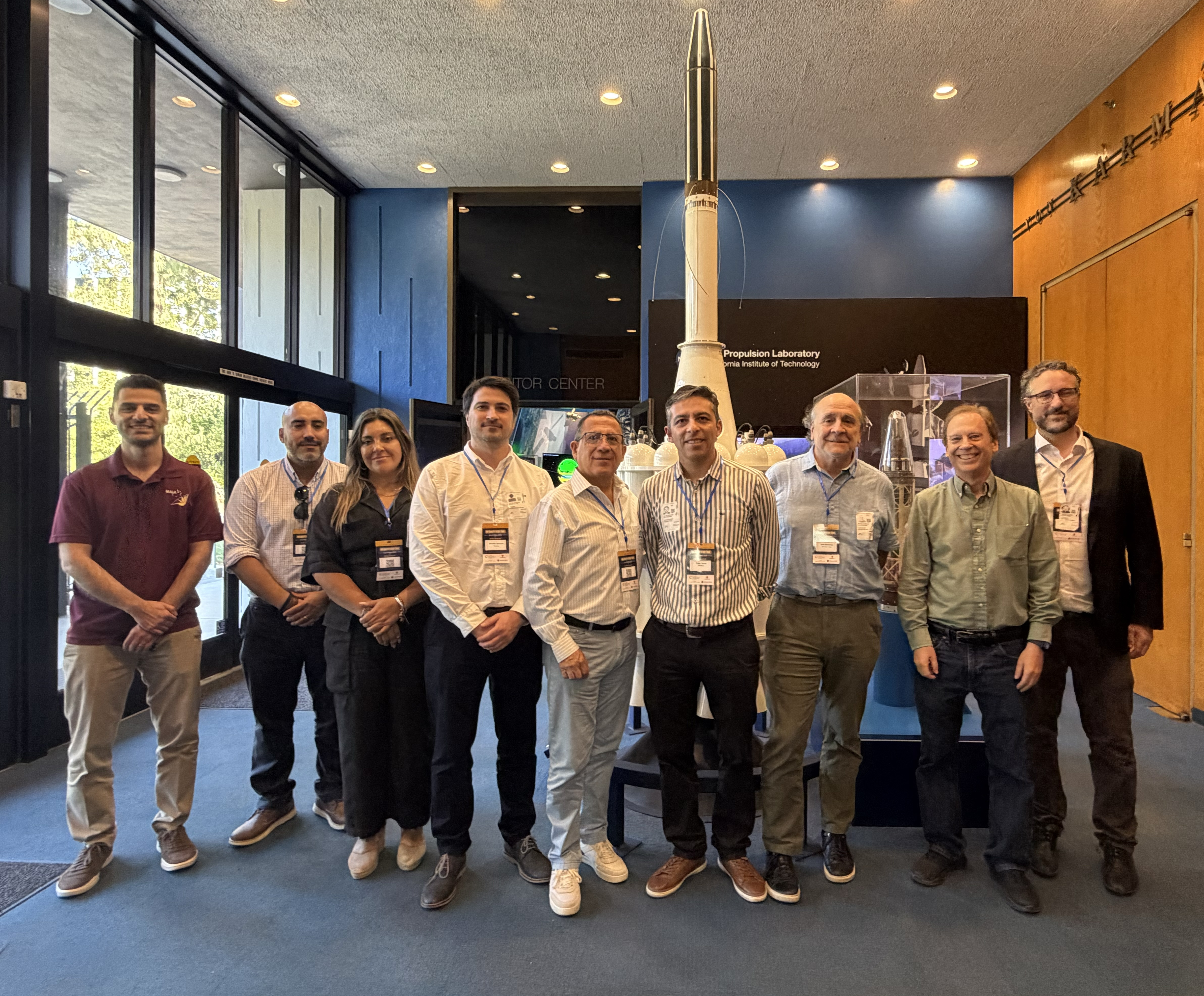
That question brought together teams from Codelco, the University of California, Davis, UC Davis Chile, and NASA's Jet Propulsion Laboratory (JPL), during a three-day technical mission to California. Coordinated by UC Davis Chile in collaboration with the UC Davis Global Affairs Office, the visit strengthened an ongoing collaboration focused on advancing applied research, environmental monitoring, and innovation to support more sustainable mining operations.
The Chilean delegation included representatives from CODELCO's Corporate Environmental Planning and Strategy, Environmental Management, Innovation, and Integrated Operations teams, as well as researchers from the UC Davis Chile Air Quality Program. Throughout the mission, participants engaged in technical discussions, laboratory visits, and strategic meetings centered on satellite-based environmental monitoring, atmospheric science, and engineering innovation.
Connecting Global Science with Real-World Challenges
The mission began at NASA's Jet Propulsion Laboratory (JPL), where the delegation met with researchers leading two of NASA's flagship Earth observation missions: David Diner, Principal Investigator of the Multi-angle Imaging SpectroRadiometer (MISR) and the Multi-Angle Imager for Aerosols (MAIA), and Sina Hasheminassab, Deputy Principal Investigator of MAIA.
Discussions focused on how satellite observations, atmospheric modeling, and ground-based monitoring can generate more accurate environmental data to support informed decision-making and improve the understanding of particulate matter and its impacts on both the environment and public health.
A central focus of the visit was MAIA, NASA's next-generation Earth observation mission designed to better understand the relationship between air pollution and human health. Through the collaboration established between CODELCO, UC Davis Chile, and the UC Davis Air Quality Research Center (AQRC), MAIA’s Chile Primary Target Area (PTA) benefits from additional air quality monitoring infrastructure to support the calibration and validation of MAIA’s satellite observations. New air quality monitoring stations are being deployed across the country to support the calibration and validation of the satellite's observations, generating high-quality environmental data while strengthening Chile's scientific and technical capabilities in air quality monitoring.
The CODELCO delegation, led by Damián Oyarzún, Corporate Director of Environmental Planning and Strategy, shared the company's priorities and operational challenges related to particulate matter management, emissions monitoring, and sustainable mining. The discussions explored how advances in remote sensing, atmospheric science, and long-term environmental monitoring could help strengthen the company's environmental management strategies while supporting evidence-based decision-making across its operations.
At Codelco, we firmly believe that sustainability is built through science, collaboration, and a long-term vision. Working alongside UC Davis Chile and engaging with the broader UC Davis research ecosystem, while actively contributing to a NASA mission such as MAIA, enables us to strengthen the Corporation's environmental management, better anticipate risks, and contribute to public knowledge about air quality and its impacts on human health
Damián Oyarzún, Corporate Director of Environmental Planning and Strategy, Codelco.
Exploring UC Davis' Research and Innovation Ecosystem
The mission continued at UC Davis, where the delegation was welcomed by Joanna Regulska, Vice Provost and Dean of Global Affairs; Simon Atkinson, Vice Chancellor for Research; Michael Lazzara, Associate Vice Provost of Academic Programs and Partnerships; Esther DeLozier, Assistant Director of Partnerships and Faculty Engagement; and Dario Cantù, Executive Director of UC Davis Chile and Ray Rossi Endowed Chair in Viticulture and Enology.
Discussions highlighted UC Davis' interdisciplinary approach to research and its longstanding commitment to international partnerships. The meetings also underscored UC Davis Chile's role as the university's innovation and collaboration hub in Chile, connecting researchers, industry, and government to develop science-based solutions that address strategic environmental and productive challenges.
A key component of the visit was a tour of the Air Quality Research Center (AQRC), one of the world's leading institutions for atmospheric research. Ann Dillner, Associate Director of Analytical Research, introduced the delegation to the Center's capabilities in air quality monitoring, chemical characterization of particulate matter, and long-term environmental observation. The delegation also learned about the IMPROVE monitoring network, whose analytical methods support one of the largest and longest-running air quality monitoring programs in the world.
The visit included discussions with Bart Ostro, whose internationally recognized research has helped advance understanding of the health impacts of air pollution. His work illustrated how high-quality environmental data can support evidence-based public health research and environmental policy.
Later, the delegation met with Anthony Wexler, Director of AQRC; Michael Kleeman, Professor of Civil and Environmental Engineering; and Christopher Cappa, Associate Dean for Graduate Studies and Online Education and Professor of Civil and Environmental Engineering. Discussions explored opportunities to strengthen collaboration around atmospheric monitoring, emissions inventories, source apportionment, black carbon, and air quality modeling—areas that align closely with the ongoing partnership among AQRC, UC Davis Chile, NASA's MAIA mission, and CODELCO.

From Research to Innovation
The final day of the mission focused on how UC Davis transforms research into practical solutions through interdisciplinary collaboration, engineering innovation, and technology commercialization.
At the UC Davis International Center, the delegation met with Raissa D'Souza, Associate Dean of Research; Christopher Cappa, Associate Dean for Graduate Studies and Online Education; Anthony Wexler, AQRC Director and faculty members Zhaodan Kong, Mitchell McCartney, and Camli Badrya from the UC Davis College of Engineering. Together, they presented research addressing environmental and industrial challenges through advanced sensing technologies, autonomous systems, wildfire monitoring, applied aerodynamics, and BioMEMS. Rather than highlighting individual projects, discussions explored how these technologies could be adapted to support more efficient environmental monitoring and operational decision-making in the mining sector.
The delegation also met with Joseph DiNunzio, Executive Director of the Mike and Renée Child Institute for Innovation and Entrepreneurship, along with Niki Peterson, Senior Program Manager and Erkin Seker, Professor of Electrical and Computer Engineering. Together, they shared UC Davis' approach to innovation, entrepreneurship, and technology transfer, highlighting how the university helps researchers move scientific discoveries beyond the laboratory by fostering industry partnerships, supporting startup creation, and accelerating the commercialization of new technologies.
The visit concluded at Aggie Square, where George Baxter, Chief Innovation and Economic Development Officer; Karl Jessen, Director of Venture Catalyst; and Mary Mumper, Administrative Officer, presented UC Davis' innovation district and its collaborative model for bringing together researchers, entrepreneurs, healthcare partners, government, and industry to accelerate innovation and regional economic development. For the delegation, the visit offered a broader perspective on how research institutions can create lasting impact by connecting scientific excellence with real-world applications.

This visit strengthens the work we are advancing through the Interdistrict Air Quality Working Group. Air quality is a challenge that can only be addressed through collaboration, and working with UC Davis Chile and UC davis will enable us to deepen our understanding of emission sources, their composition, and plume behavior, while leveraging world-class expertise and technologies to develop innovative solutions that strengthen our environmental management and support decision-making across operational, regulatory, and community contexts.
Rocío Uribe, Mine Services Engineer, Ministro Hales Division.
Looking ahead
Beyond knowledge exchange, the visit served as a working platform for identifying future opportunities between UC Davis Chile, UC Davis, NASA JPL, and CODELCO. Among the topics explored were air quality monitoring, environmental data integration, remote sensing, advanced sensing technologies, atmospheric modeling, and applied research to support more sustainable mining operations.
The mission fostered valuable exchanges between researchers and industry leaders, creating new opportunities to explore partnerships in areas such as air quality, environmental monitoring, remote sensing, and sustainable mining. As UC Davis' innovation and collaboration hub in Chile, UC Davis Chile will continue facilitating dialogue and connecting scientific capabilities with the needs of industry and public policy to support the development of science-based solutions to shared environmental challenges.